Three years ago, sending a wedding invitation by WhatsApp would have horrified your future mother-in-law. In 2026, it's how 22% of US couples invite their guests — and the curve is steeper every quarter.
This is not a guide convincing you that digital is better. There are real reasons paper still wins for some weddings (your grandfather's wedding folder, the keepsake-loving aunt, the formal Episcopal ceremony with engraved everything). This is an honest breakdown of what animated wedding invitations actually are, what they cost, who they work for, and the three questions that should decide which way you go.
By the end, you'll either be confidently ordering paper from Minted, or sending your animated invite by WhatsApp tonight. Either is a good answer — but only one of them is the answer for your wedding.
What an animated wedding invitation actually is
It's a short video file. That's it.
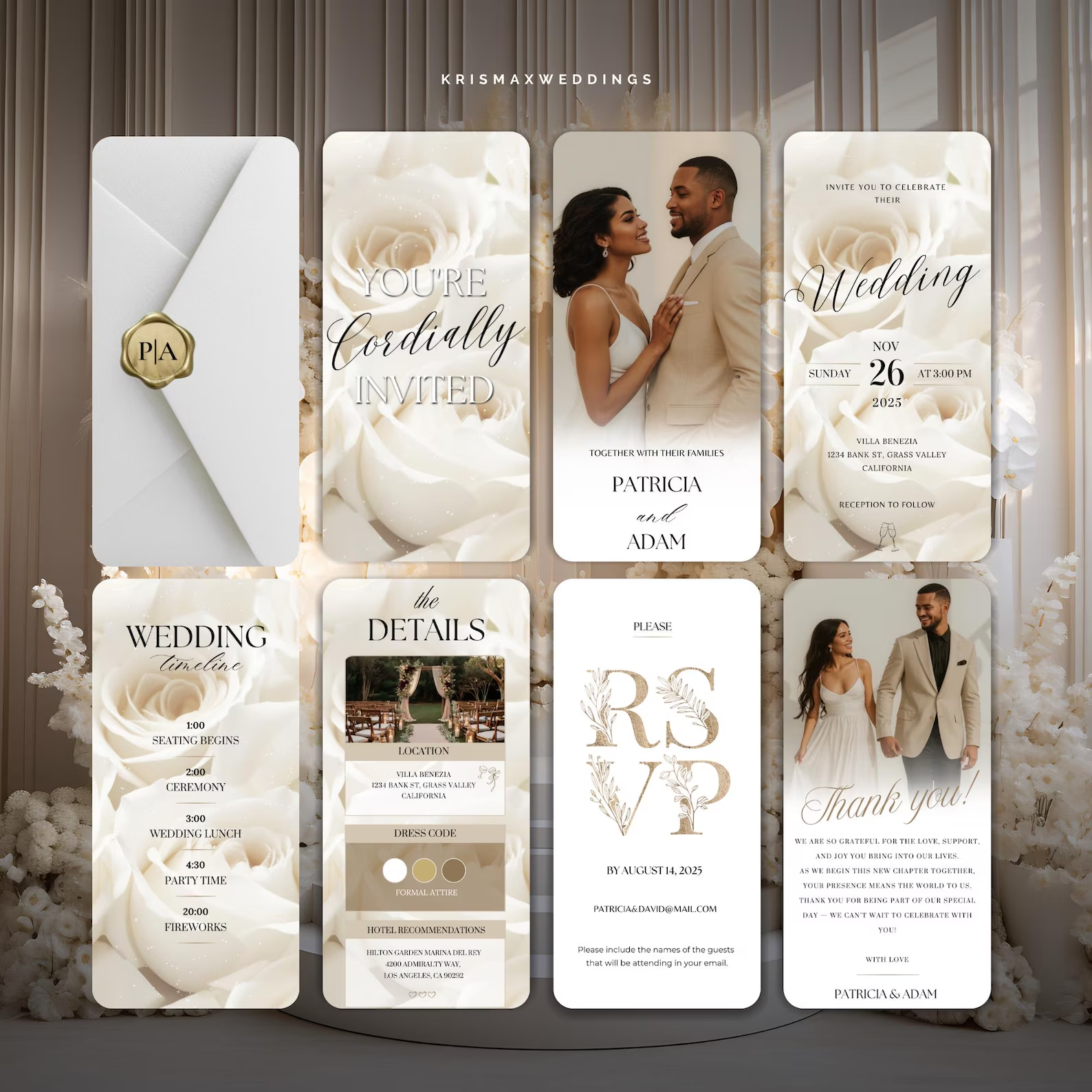
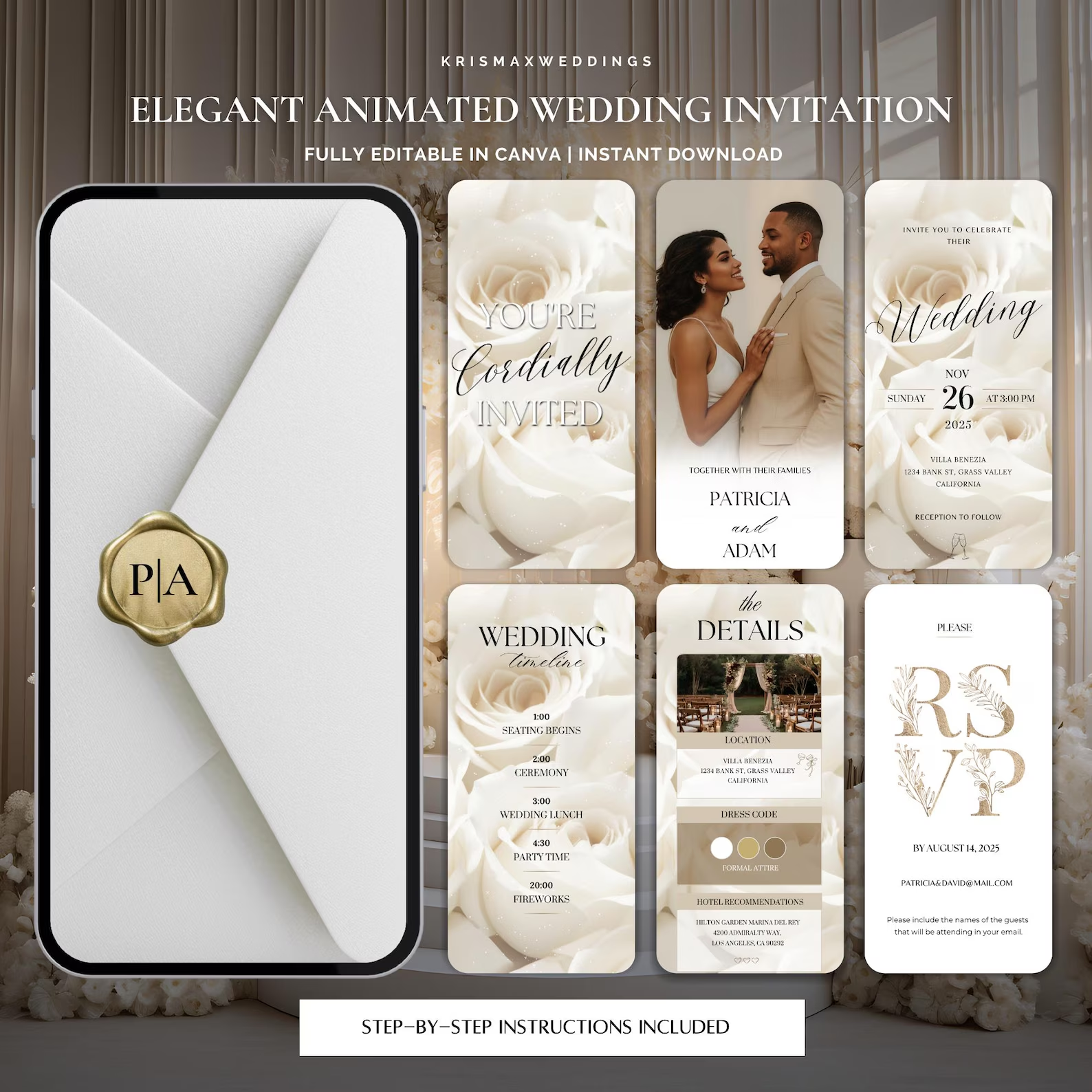
Specifically: a 15-30 second MP4 or animated GIF, vertical or square, that displays your wedding details with motion design. The visual style ranges from cinematic (close-ups of dripping wax seals, ribbon-bound paper unfurling, hands holding bouquets) to typographic (script-typography animating in over a still background) to fully illustrated (botanical motifs blooming open).
The shared characteristic: when your guest taps their notification, the invitation moves. Music plays. Their name might appear personalized. Then they see your date, venue, and how to RSVP.
What it is NOT:
- A static PDF with the word "animated" in the description
- A video so generic it could be anyone's wedding
- A 5-minute "story of how we met" reel (that's a save-the-date trailer — different category)
- A Canva slideshow exported as MP4 with no motion design
Done well, an animated invitation feels like a 30-second wedding magazine spread that arrived in your guest's pocket. Done poorly, it feels like an Office Depot ad. The difference is in the design system — colors, typography, restraint, and music choice. Most of the templates that look bad use Comic Sans-adjacent fonts and copyright-free royalty music that screams "free."
Why couples are switching (the honest 5 reasons)
1. Speed — yours and your printer's
Paper invitations take 6-10 weeks: 2 weeks for design back-and-forth, 1 week for proofs, 2-3 weeks for letterpress production, 1 week for envelope addressing, 1-2 weeks shipping to your door. Then you address each one, stamp it, and mail it.
Digital takes 5 minutes once you've picked a template. You type names + date + venue in Canva, export, share.
For couples planning a wedding in under 6 months (about 38% of US couples per The Knot's 2025 Real Weddings Study), digital isn't a preference — it's a feasibility question.
2. Cost (the awkward number)
The Knot's 2025 study put the average US wedding stationery budget at $510 for 100 guests. That covers save-the-dates, invitations, and RSVP cards — printed, addressed, mailed.
Animated digital invitations from a designer template: $19.99 - $49.99 for the same set, sent to unlimited guests.
We did a full cost breakdown here. The short answer: redirected to the open bar, $480 buys you about 24 craft cocktails. That's a real upgrade your guests will remember more than a textured envelope.
3. International guests
If your guest list spans 3+ countries (which is increasingly common — destination weddings are up 28% YoY since 2023), paper invitations become a logistics problem. Different postal services, different costs, different delays, some packages held in customs for 3 weeks.
Digital lands in 0.4 seconds. Your cousin in Sydney, your grandfather in Casablanca, and your maid of honor in Toronto all get the same beautiful invitation at the same moment. Multilingual support helps too — your audience reads what they understand.
4. Animation does things paper can't
A peony slowly blooming open behind your names. A eucalyptus stem swaying as if in a breeze. Your engagement photo crossfading to your wedding date. Subtle music swelling.
These aren't gimmicks — they're how the format finally caught up with how your guests consume content. The 30-second invitation video is the natural medium for the same audience that consumes 30-second wedding planning Reels on Instagram every day.
5. They get kept
This is the surprise reason that has the strongest emotional weight: animated invitations live in your guest's camera roll. Three weeks after the wedding, your sister still has it. A year later, she opens it on your anniversary.
Paper invitations are recycled by Tuesday after the wedding. That's not a value judgment — it's just what happens with paper.
“We thought my grandmother would hate it. She watched the animated invite four times before the wedding, then asked me to send it to her sister so they could "watch it together."
”
Three honest reasons to stick with paper
Not every wedding is the right wedding for digital. The three scenarios where paper still wins:
1. Highly formal ceremonies
Black-tie, white-tie, deeply traditional religious ceremonies (Episcopalian, Greek Orthodox, certain Catholic dioceses) often expect engraved or letterpress invitations. The medium IS part of the formality signal. Sending these guests a video invitation feels like wearing jeans to the rehearsal dinner — technically allowed but socially off-tone.
If your invitation says "request the honour of your presence" (with the British spelling), you're in formal territory. Print it.
2. Guests genuinely without smartphones
The percentage of US adults over 65 with smartphones reached 79% in 2024 (Pew Research). But that means 21% don't — and many of those are exactly the relatives who'd be most heartbroken to feel excluded.
The hybrid solution: send digital to your 50-60 connected guests. Print 5-10 traditional cards for grandparents, aunts who insist, anyone whose address ends in "Retirement Community." The hybrid costs ~$40 in print, not $400.
3. You want a physical keepsake
Some couples are emotionally attached to the idea of their kids one day finding their wedding invitation in a drawer. A video file in 2055's Apple Cloud doesn't deliver that. A letterpress card in tissue paper does.
If this matters to you (no judgment — it's a beautiful instinct), print one physical copy of your animated design as a flat card. Frame it. Done.
How animated wedding invitations actually work
The end-to-end flow most couples follow in 2026:
- Browse templates on Digittify, Etsy, or Canva → pick one that matches your aesthetic
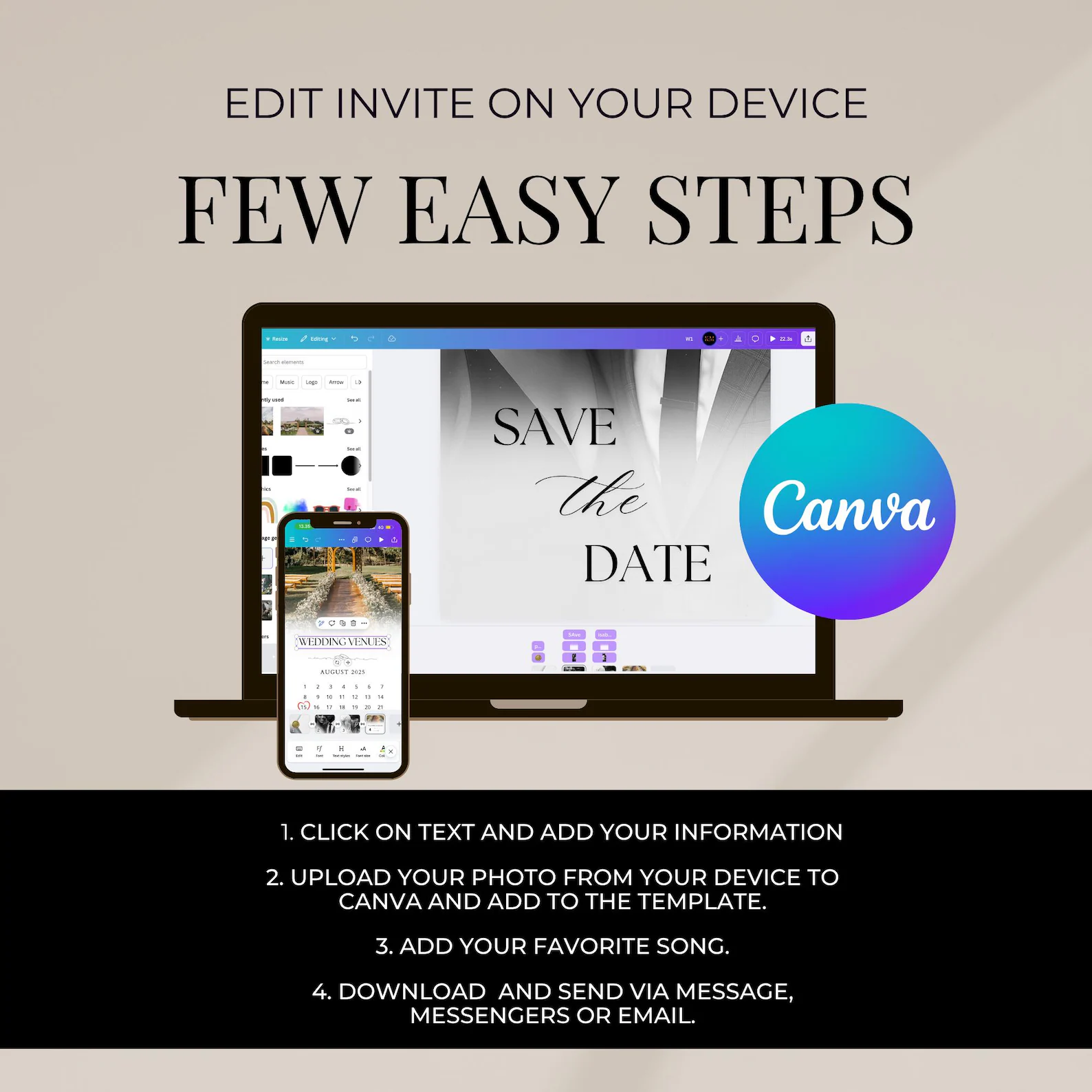
- Open in Canva with your free account — the template loads instantly
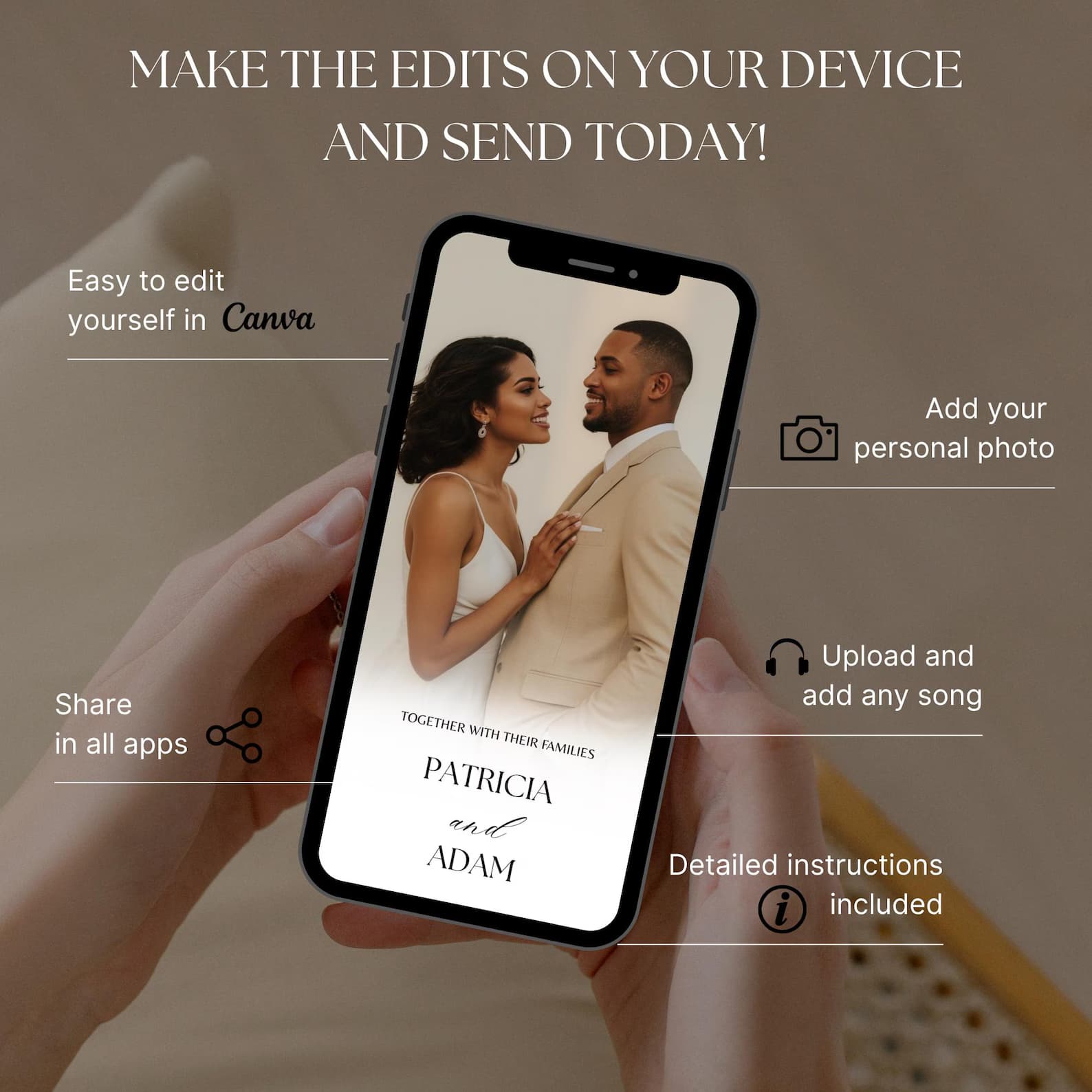
- Customize: type your names, date, venue. Drop in your engagement photo (drag + drop). Pick from 5+ color palettes. Optionally upload your first-dance song.
- Export as MP4 (HD) or animated GIF
- Share by WhatsApp, iMessage, email, or generate a QR code for printed save-the-date magnets
Total time after picking the template: 5-15 minutes depending on how many photos you swap. No designer email chains. No proof revisions. No print shop.
See how the customization actually works.
Every Digittify template ships with a step-by-step PDF guide. Open it on a laptop while you have Canva open on the other side. Five minutes in, you'll have your names in your fonts in your colors — ready to send.
What it costs (honest 2026 pricing)
| Path | Cost (100 guests) | Time to send |
|---|---|---|
| Bespoke designer + letterpress | $1,200-$2,400 | 8-12 weeks |
| Custom (Minted, Zola, Paper Source) | $400-$700 | 4-6 weeks |
| Print-at-home + DIY | $80-$200 + your time | 2-3 weekends |
| Animated digital invitation (Digittify) | $19.99-$49.99 | 5 minutes |
| Free Canva template + your design time | $0 + 4-12 hours | 1 weekend |
The free Canva path is real — Canva itself offers free wedding templates. They're mediocre. Most look like they were designed by a marketing intern in 2018. If your aesthetic standards are below "magazine cover," free works. If you want it to feel intentional, you're spending $20-50 on a designer template.
Three things that make a digital invitation feel cheap
If you're considering this route, avoid these three rookie mistakes:
1. Cluttered composition. Your phone screen is 6.5 inches. Trying to fit photos + names + venue + date + dress code + map + RSVP details all in one frame produces visual soup. Pick the 4 most important elements and let the rest breathe.
2. Generic stock music. Free royalty-free music sounds free. If you're using music, either license a real track (~$10-20 on Musicbed or Artlist) or upload an instrumental cover of your first-dance song.
3. Mismatched typography. Mixing 4 fonts is the most common amateur mistake. Pick 2: one display font (Cormorant, Italianno, Playfair) for the romantic typography, one sans-serif (Inter, Geist) for everything else.
When to send your animated invitation
The timeline rules carried over from paper:
- Save-the-date: 6-12 months before the wedding (sooner if destination)
- Formal invitation: 6-8 weeks before (domestic), 10-12 weeks (destination)
- Reminder + RSVP follow-up: 2 weeks before, only to non-responders
The advantage with digital: you can send the formal invitation later than paper. Most Digittify couples send their main invite 4 weeks out — closer to the date when guests are actually thinking about scheduling.
We have a full save-the-date guide here.
Frequently asked
- Are animated wedding invitations considered tacky?
In 2026, no. The aesthetic has matured — modern animated invitations from designer-led studios feel as elevated as letterpress. The 'tacky' connotation came from early-2010s e-vite platforms with cartoon graphics. Today's leading digital wedding stationery looks closer to a Vogue editorial than an Evite.
- What's the cheapest way to send a digital wedding invitation?
The cheapest path is a free Canva wedding template + your own design time (4-12 hours). The cheapest premium path is a designer template from a studio like Digittify ($19.99-$49.99), which gets you a polished aesthetic in 5 minutes.
- Will older guests be offended by digital invitations?
Most won't, but some will. The safe approach is hybrid — send digital to your 50-60 connected guests, print 5-10 traditional cards for grandparents and the elderly relatives who'd be most disappointed. Total print cost: ~$40 vs $400 for all paper.
- Can I add music to my animated wedding invitation?
Yes — most premium animated invitation templates support uploading your own audio (your first-dance song instrumental, a piano cover, ambient music). Canva accepts MP3 uploads in templates. Keep it under 30 seconds and instrumental to avoid copyright issues on social shares.
- How do animated invitations work for international guests?
Better than paper. Digital invitations send instantly to any country via WhatsApp, iMessage, or email — no postal delays, no customs, no language barrier if your invitation supports multiple languages. The same animated MP4 plays identically on a phone in Tokyo or Paris.
The 30-second decision framework
Ask yourself these three questions:
- Is your wedding before October 2026? If yes, digital is probably the only feasible option for full stationery sets.
- Are you redirecting any saved budget back into the wedding day? If yes, the $400 saved goes a long way at the bar or florist.
- Do most of your guests use smartphones? If yes, digital lands. If 30%+ of your list is over 75, lean hybrid.
If two of three are yes, you're a digital-first couple. The remaining question is just which template.
See your wedding in motion before you decide.
Every Digittify template includes a live animated preview. Watch how the invitation actually moves, hear the music, see your photo in place — before you commit. Five minutes to your wedding details on screen.